what Drives Diamond Prices?
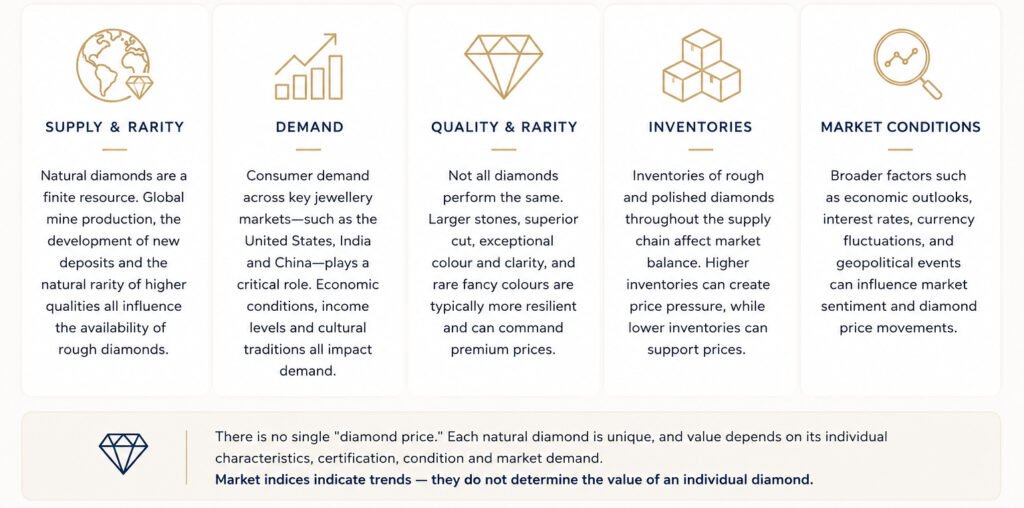
Natural diamond prices are influenced by a complex combination of rarity, quality, supply, consumer demand and global market conditions. Unlike standardized commodities, diamonds cannot be valued by weight alone. Every natural diamond has its own combination of characteristics, meaning that price movements can vary considerably between different sizes, qualities and categories.

Understanding Diamond Prices
Supply and Natural Rarity
Natural diamonds are a finite geological resource formed deep within the Earth over billions of years. The availability of new rough diamonds depends on existing mines, production levels and the discovery and development of economically viable deposits.
Changes in global mine production can therefore influence the longer-term balance between supply and demand. New diamond mines require significant investment and can take many years to develop, while mature mines eventually become depleted or uneconomic to operate.
Consumer Demand
Demand for natural diamonds is strongly influenced by the world’s major jewellery markets. The United States remains particularly important, while India and China also play significant roles in global demand.
Economic confidence, disposable income, jewellery trends, weddings, gifting traditions and changing consumer preferences can all affect demand. Stronger demand can support prices, while periods of weaker consumer spending can place pressure on the market.
Diamond Quality and Rarity
Not all natural diamonds respond to market conditions in the same way.
Carat weight, cut, color and clarity remain fundamental to valuation, but rarity also plays an important role. Larger diamonds, exceptional qualities, unusual characteristics and certain fancy colored diamonds may have very different supply-and-demand dynamics from more widely available commercial stones.
For this reason, broad diamond price indices provide useful information about market direction but cannot determine the value of an individual diamond.
Rough and Polished Diamond Inventories
Inventory levels throughout the diamond supply chain can also influence prices. When miners, manufacturers or dealers hold elevated inventories, additional supply can place pressure on the market. When inventories decline and demand remains healthy, the market may become more balanced.
The relationship between rough-diamond production, cutting and polishing activity, dealer inventories and retail demand is therefore an important indicator of overall market conditions.
A Market Defined by Individual Diamonds
Perhaps the most important principle for buyers to understand is that there is no single “diamond price.”
Two natural diamonds with the same carat weight can have substantially different values depending on their cut, color, clarity, proportions, fluorescence, certification and overall desirability.
At DiamondsAntwerp.com, we therefore look beyond headline price movements to examine the underlying factors shaping the natural diamond market and what those developments may mean for buyers, collectors, investors and industry professionals.